
1. Introduction
“By poetry we mean the art of employing words in such a manner as to produce an illusion on the imagination, the art of doing by means of words what the painter does by means of colors.”
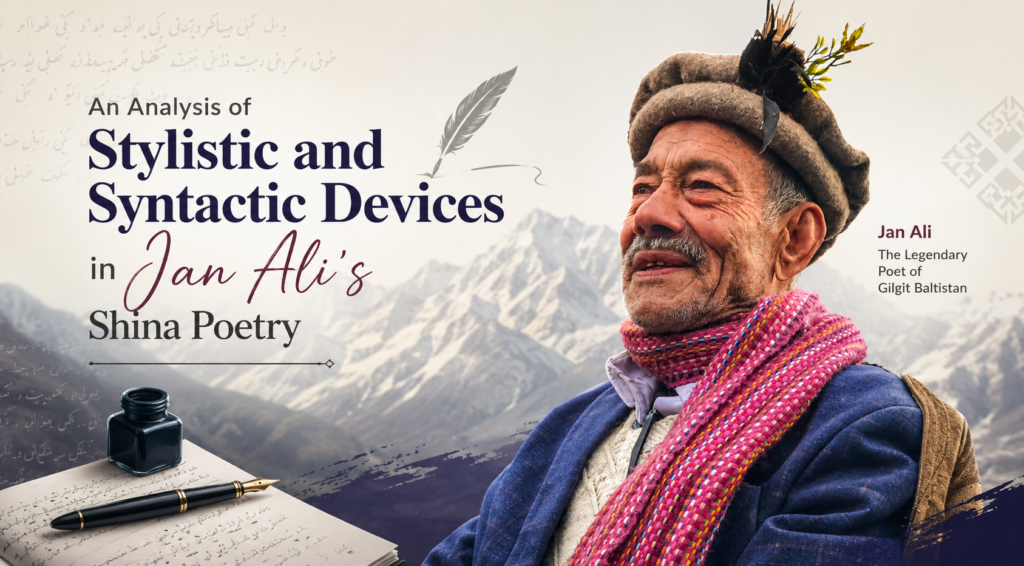
This definition, offered by Thomas Babington Macaulay in his Essays on Milton (1895), draws a vivid parallel between a poet and a painter. Just as a painter uses different colors to bring a canvas to life, a poet uses different linguistic devices to paint emotions onto the page. This essay takes that metaphor to action. It is an analysis of the poetry of Jan Ali, a celebrated Shina-language poet and singer from Gilgit-Baltistan, Pakistan, examining the stylistic and syntactic devices he uses to construct meaning, beauty, and emotional resonance.
Shina is an endangered indigenous language with a rich but largely undocumented oral literary tradition. As a native speaker of Shina, the author of this essay is positioned as both analyst and insider, bringing cultural and linguistic knowledge to bear on material that has received little scholarly attention. The analysis focuses on seven poems by Jan Ali, examining five key stylistic and syntactic devices: metaphor, simile, imagery, polysemy and ambiguity, and code-switching. The essay argues that these devices, taken together, reveal a poet deeply rooted in classical South Asian literary tradition while simultaneously engaging with the lived cultural reality of Gilgit-Baltistan.
The essay is structured as follows. Section 2 provides background on the Shina language and its community of speakers. Section 3 introduces the poet. Section 4 brings the topic of stylistic analysis and the key theoretical tools used. Section 5 outlines the data and methodology. Section 6 presents the analysis, organized by device. Section 7 concludes with a summary of findings.
2. Language Background: Shina
Shina is a Dardic language belonging to the Indo-Aryan branch of the Indo-European language family. It is spoken primarily in the Gilgit-Baltistan region of northern Pakistan, as well as in parts of Khyber Pakhtunkhwa, Baluchistan, and in the Ladakh district of India. Estimates of speaker numbers vary considerably across sources, ranging from approximately 1.1 million to as many as 5 million, reflecting both the difficulty of census-taking in mountainous regions and the contested boundaries of the Shina-speaking community (Radloff, 1992).
Shina has historically been an oral language. A script has only recently been developed, and the body of published written material remains very limited. This places Shina in a precarious sociolinguistic position: it is considered endangered, as younger generations, many of whom migrate to urban centers in Pakistan or abroad for educational and professional opportunities, increasingly lose active competence in the language. Over generations, families become disconnected from their linguistic and cultural roots.
Despite this, Shina maintains a vivid presence in music and oral poetry. Songs are performed at festivals, weddings, and community gatherings, and it is through these expressive forms that the language continues to live. Shina exists in a diglossia (refers to a situation where two distinct languages coexist in a speech community, each used in different social contexts or functions) relationship with Urdu, the national language of Pakistan, which dominates in education, government, and media. This contact situation has led to considerable borrowing from Urdu, Persian, and Arabic, a phenomenon that is visible in Jan Ali’s poetry itself, as discussed in Section 6.
Academic research on Shina is next to none. This essay therefore relies heavily on the author’s own native-speaker knowledge, supplemented by available linguistic sources. The relative absence of scholarly literature is itself noted as significant: this analysis represents a contribution to an under-documented field.
3. The Poet: Jan Ali
Jan Ali is one of the most celebrated poets and singer-musicians in the Shina-speaking community of Gilgit-Baltistan. He has been active as a poet and performer since the 1950s, producing a body of work that exceeds forty songs. Abbas (2022) describes him as arguably one of the most well-known poet-historians of the region, a leading poet, flute-player, and singer of Shina songs whose work was broadcast on Radio Pakistan Rawalpindi from the 1950s and on Radio Pakistan Gilgit from 1977 onwards. At a time when radio was the sole medium of mass communication, this platform gave Jan Ali an audience that few other Shina poets could match.
What distinguishes Jan Ali from other Shina poets is the remarkable thematic diversity of his work. Abbas (2022) notes that his poetry spans politics, unattained love, nostalgia, education for girls, sectarianism, religion, and social commentary, a breadth that makes him, in Abbas’s phrase, a primus inter pares among the Shina poets of Gilgit-Baltistan. Crucially, Abbas further observes that Jan Ali’s metaphor, imagery, simile, and irony are essentially local in character. He creates images rooted in the landscape, culture, and daily life of GB, meaning his words resonate deeply with a community that may not be familiar with universal poetic conventions but can readily identify with his observations.
Jan Ali’s appeal transcends sectarian, ethnic, and regional divisions within Gilgit-Baltistan (Abbas, 2022), making him a unifying cultural voice in a region that is often characterized by its diversity. For the purposes of this essay, his large and thematically varied corpus makes him an ideal subject for linguistic analysis: where many Shina poets have left only a handful of documented works, Jan Ali’s extensive output and his continued relevance in the digital age, with his recordings widely shared on YouTube and social media opens significant scope for researchers working on an otherwise under-documented language.
4. Topic: Stylistic and Syntactic Analysis of Poetry
This essay applies the framework of stylistics, the linguistic study of literary texts, to the poetry of Jan Ali. Stylistics examine how language choices create meaning and effect, attending to both syntactic structure (how sentences are formed) and semantic content (what words mean and how they interact).
A central concept in this analysis is Leech’s (1969) notion of foregrounding, the deliberate deviation from ordinary language use to create emphasis and draw the reader’s attention to meaning. Poetry, more than any other literary form, depends on foregrounding to achieve its effects. The following devices are identified and defined for the purpose of this analysis:
Metaphor is a direct comparison between two things that share a quality, without using comparison words. Lakoff and Johnson (1980) argue that metaphor is not merely a literary ornament but a fundamental cognitive tool through which humans understand and structure their experience of the world.
Simile is a comparison between two things using comparison words such as ‘like’ or ‘as’. Leech and Short (1981) note that simile, like metaphor, creates emotional and intellectual resonance in the reader, though it foregrounds the act of comparison more explicitly.
Imagery refers to language that appeals to the senses and creates vivid mental pictures. Leech (1969) distinguishes between visual, natural, and bodily imagery, all of which appear in Jan Ali’s work.
Polysemy and Ambiguity refer to words or phrases that carry multiple simultaneous meanings. Empson (1930) identifies ambiguity as a central and deliberate feature of poetic language, arguing that multiple meanings enrich rather than obscure poetic expression.
Code-switching refers to the alternation between two or more languages within a single text or utterance. Myers-Scotton (1993) argues that code-switching is socially and expressively motivated, reflecting the speaker’s identity, relationships, and communicative intent.
5. Data and Methodology
The data for this essay consist of seven poems by Jan Ali, a poet and singer who has been active in Gilgit-Baltistan for approximately half a century. The poems selected are: Jakur Tha-thr Thay, Yar Mah Thai Khayalor, Ya Khuda Mah Lok, Tu Guch Umeed, Toum Shah Churuk, Muto Dudh, and Ali Ali. These were selected because they represent different periods of Jan Ali’s output and cover a range of themes: romantic love, political grief, spiritual devotion, and social observation.
The author of this essay is a native speaker of Shina from Gilgit-Baltistan. This positions her as an insider researcher, a role that carries significant analytical advantage: cultural and linguistic meanings that would be opaque to an outside analyst are accessible through lived knowledge. This is particularly important for the analysis of metaphor, where cultural context determines meaning. The author also worked on an oral history project in which folk songs of the region were preserved, giving her further grounding in the poetic traditions of Shina.
Each poem is presented in Romanized Shina transcription, followed by a word-by-word gloss, and then a full English translation. The analysis focuses on semantics and stylistic patterning; phonological analysis is outside the scope of this essay.
6. Analysis
The analysis of Jan Ali’s seven poems reveals consistent and deliberate use of stylistic devices. These devices do not operate in isolation they frequently overlap and reinforce one another. The following sections treat each device in turn, with examples drawn from across the corpus.
6.1 Metaphor
Metaphor is Jan Ali’s most prominent and consistent device. As Lakoff and Johnson (1980) argue, metaphors do not merely decorate language they reveal the conceptual frameworks through which a speaker understands the world. In Jan Ali’s case, his metaphors reveal a poet who thinks in terms of historical tragedy, spiritual devotion, and the natural landscape of Gilgit-Baltistan.
Example 1: Gilgit as Kufa and Sham
masho wai kharan hn makar tutang jhang-ai maidan nay
in.front standing is for.me dark war-GEN land is
‘In front of me stands a dark land of war’
Tayn gileet gee bilin-la quufa ga shaam-nay
Now Gilgit has become Kufa and Sham is
‘Gilgit has now become Kufa and Sham’
In this stanza from Jakur Tha-thr Thay, Jan Ali directly equates Gilgit with Kufa and Sham. Two cities of deep historical and religious significance in Shia Islamic tradition. Kufa is where Imam Hussain was abandoned and betrayed by those who had pledged support before the Battle of Karbala. Sham (Damascus) is where his family was taken as prisoners following the massacre. By mapping these places onto Gilgit, Jan Ali elevates a contemporary grievance to the scale of historical tragedy. This is not a casual reference, for a Shia audience, these names carry enormous emotional weight. The metaphor simultaneously communicates political suffering and spiritual resonance, making it one of the most culturally loaded moments in the corpus. It also reveals the poet’s religious identity, his sense of betrayal, and his perception that something has gone deeply wrong in his community.
Example 2: The Lantern and the Moth (Intertextuality)
Tu mai laltain bil tou
You my lantern become if
‘If you become my lantern’
Mah thai parvana sahi
I your moth/parvana will.be
‘I will become your moth’
This example from Yar Mah Thai Khayalor uses a metaphor deeply embedded in the Persian and Urdu classical poetic tradition: the parvana (moth) who circles a flame until it burns. The beloved is the lantern; the poet is the moth who willingly destroys himself for love. This is a well-known image in the works of poets such as Rumi and Ghalib. Jan Ali’s deployment of it in Shina is an example of what scholars call intertextuality, the conscious borrowing of an image from a broader literary tradition. This is analytically significant: it positions Shina poetry not as an isolated indigenous form but as a branch of the wider classical South Asian literary tradition. It also signals Jan Ali’s own literary education and his awareness of the broader poetic canon in which he situates his Shina verse.
6.2 Simile
While metaphor makes direct identifications, Jan Ali’s similes foreground the act of comparison, inviting the listener to consciously measure the beloved against the natural world. Leech and Short (1981) note that simile creates both intellectual and emotional engagement, as the reader participates in the act of comparison.
Example 1: The Moon
Yunay parulik hnay bai asmano taaro maja
Moon like are(you) sitting sky stars with
‘You are sitting with the stars like the moon’
From Toum Shah Churuk, this simile places the beloved in a cosmic register. She is not merely beautiful, she is celestial, elevated among others as the moon is elevated among stars. The comparison also implies distance: the moon, however brilliant, is unreachably far from the earth. Jan Ali uses natural imagery not just for decoration but to encode the emotional condition of longing.
Example 2: The Honeybee
Du-dunay touch ashiq hn shakarai machari hnay
Beetles your lovers are sugar/honey bee are
‘Beetles are in love with you, you are like a honeybee’
Also from Toum Shah Churuk, this simile is grounded in the natural world of Gilgit-Baltistan, a green, mountainous region where connection to land and nature is deeply embedded in cultural identity. The beloved is compared to a honeybee: at the center of attention, sweet, productive, and compelling. The beetles who circle her represent all those who love her without possessing her. The simile is at once affectionate and melancholic. He, like all the others, is merely orbiting something he cannot hold.
6.3 Imagery
Jan Ali’s poetry is saturated with imagery, particularly natural imagery and body imagery. Leech (1969) notes that imagery is one of the primary means by which poetry makes abstract emotions concrete and sensory. In Jan Ali’s work, the body and the landscape of Gilgit-Baltistan function as the two dominant registers through which feeling is expressed.
Example 1: Body Imagery
thai tanulay ounty kagazai sanay gayn nay
your delicate lips paper-GEN made are
‘Your delicate lips have been made of paper’
thai achiye malaikanis mohbatai sanay gayn nay
your eyes angels-GEN love-GEN made are
‘Your eyes have been made of love by angels’
From Ya Khuda Mah Lok, this sequence of body imagery constructs the beloved almost as a divine creation: her lips are as delicate as paper, her eyes composed of love. The repeated grammatical structure ‘made of’ creates a cumulative effect, as though the poet is noting a miracle. This kind of detailed sensory description of the beloved’s body is a recognizable feature of classical ghazal poetry, and its presence in Shina again points to Jan Ali’s engagement with the broader classical tradition.
Example 2: Natural Imagery
Luxum bush tou thai ko bain, tu mai shamai gash hnay na
Luxum who will.become your I.don’t.know you my evening waterfall are
‘I don’t know who will become your Luxum; you are my waterfall of evening’
From Toum Shah Churuk, this line uses natural imagery specific to the Gilgit-Baltistan landscape. Luxum is a flowering plant traditionally worn by women in their hair on special occasions, culturally equivalent to the gajra (jasmine garland) in Urdu-speaking culture. Calling her his ‘waterfall of evening’ evokes beauty, movement, and a particular quality of light the, golden late-day light on mountain water. These images are distinctly and specifically rooted in the geography and cultural practices of Gilgit-Baltistan, giving Jan Ali’s imagery a strongly local character.
6.4 Polysemy and Ambiguity
Empson (1930) argues that poetic ambiguity, the presence of multiple simultaneous meanings, is not a flaw but a resource, enriching the text by allowing it to mean more than one thing at once. Jan Ali uses this resource with considerable skill.
Example 1: The Madman Line
Daru jago kach theek hnus mah tukech deewana sahi
Outside people for fine am I with.you madman am
‘For the outside world I am fine; with you I am a madman’
From Yar Mah Thai Khayalor, this line is polysemous. The word deewana can mean both ‘madman’ and ‘deeply, hopelessly in love’, a distinction that collapses in the context of classical love poetry, where the lover’s madness is precisely his devotion. Jan Ali simultaneously presents himself as socially functional (fine to the outside world) and privately consumed (deewana in love). The line captures the gap between how a person appears to others and what they feel inside, using a single word to hold both meanings at once.
Example 2: Kill or Cry
Khush theegayt hayaraynay khush nay theegayt mara-raynay
Happy make.you laugh happy not make.you cry/kill when
‘When you are happy you make me laugh; when you are not, you make me cry / kill me’
From Toum Shah Churuk, this line contains a deliberate phonological ambiguity in the Shina original. The phrase mara-raynay can be parsed as either ‘making me cry’ or ‘killing me’, as both readings are phonologically identical in spoken Shina. This is a rare instance where phonological form and semantic meaning interact to produce ambiguity, the listener cannot distinguish between the two meanings, and Jan Ali does not resolve the ambiguity. Whether the beloved causes his tears or his death, the effect of her displeasure is total. The ambiguity does not confuse; it intensifies.
6.5 Code-Switching
Myers-Scotton (1993) argues that code-switching is motivated by social, expressive, and identity-related factors. In Jan Ali’s poetry, code-switching occurs in three distinct forms: borrowing from Urdu, borrowing from Persian/Arabic, and, most strikingly, the incorporation of English words rendered in Shina phonology.
Example 1: English in Shina
School ee-ay xas bay gay la toum darayl maxhtar gini
School to went with your dear teacher along
‘You went to school with your dear teacher’
From Muto Dudh, the word darayl is a Shina phonological rendering of the French/English word dear, likely absorbed through Pakistan’s English-medium education system. Similarly, school is used in its English form. This kind of switching reflects the linguistic reality of educated speakers in Gilgit-Baltistan, who move between Shina, Urdu, and English across different domains of life. When Jan Ali incorporates these words into poetry, he is grounding it in the contemporary sociolinguistic reality of his community. This is consistent with Myers-Scotton’s (1993) argument that code-switching reflects the speaker’s identity and social world.
Example 2: Political Code-Switching
Nee Gareeb awam say sasta coat ot khush thaynayn
This poor public cheap coat with happy are
‘This poor public is happy with cheap coats’
chairmanee ga memberis toum votot khush thaynayn
chairman-PL and member-PL their votes-with happy are
‘Chairmen and members are happy with their votes’
From Ya Khuda Mah Lok, Jan Ali uses English political vocabulary, ‘chairman’, ‘member’, ‘vote’, embedded within Shina grammatical structures, including the Shina plural suffix -ee applied to ‘chairman’. This is a sophisticated form of code-switching in which foreign lexical items are morphologically integrated into the host language. The effect is also satirical: the poet borrows the language of modern democratic politics to expose its hollowness. The people are satisfied with cheap coats; the politicians with votes. The borrowed vocabulary carries with it the associations of a system that, Jan Ali implies, has failed his community.
7. Conclusion
This essay has analyzed five stylistic and syntactic devices in the poetry of Jan Ali: metaphor, simile, imagery, polysemy and ambiguity, and code-switching. Across seven poems, these devices reveal a poet of considerable range and sophistication, whose work is simultaneously rooted in classical South Asian literary tradition and deeply engaged with the contemporary cultural and political life of Gilgit-Baltistan.
Several broader findings emerge from the analysis. First, Jan Ali’s metaphors are never merely decorative, they carry cultural, religious, and political weight, as in the comparison of Gilgit to Kufa and Sham. Second, his use of classical imagery and intertextual references positions Shina poetry within the wider Persian and Urdu literary canon, challenging the assumption that an endangered indigenous language is necessarily a marginalized or isolated one. Third, his code-switching reflects the sociolinguistic reality of his community, where Shina, Urdu, and English coexist and interact.
This analysis has been necessarily limited by the scope of the essay. A fuller study might examine phonological devices such as rhyme and rhythm, explore Jan Ali’s poetry diachronically across his career, or compare his work systematically with female Shina poets to investigate gendered differences in poetic voice. Nevertheless, the analysis demonstrates that Shina poetry is a rich and linguistically complex tradition, and that Jan Ali’s work merits the scholarly attention it has not yet received.
Bibliography
- Ali, Jan. 2025. Best Collection unplugged | Vocals: Jan Ali. GB Folks. YouTube, May 25, 2025. https://youtu.be/1CfUPWuCGoU?si=IhcLc3BdpJp9NONO
- Abbas, Zameer. 2022. ‘A People’s History of Gilgit-Baltistan (1947–2022).’ In Beyond the Mountains. Part II: Contemporary Histories.
- Backstrom, Peter C., and Carla F. Radloff. 1992. Languages of Northern Areas. Sociolinguistic Survey of Northern Pakistan, Vol. 2. Islamabad: National Institute of Pakistani Studies, Quaid-i-Azam University and Summer Institute of Linguistics.
- Empson, William. 1930. Seven Types of Ambiguity. London: Chatto & Windus.
- Lakoff, George & Mark Johnson. 1980. Metaphors We Live By. Chicago: University of Chicago Press.
- Leech, Geoffrey. 1969. A Linguistic Guide to English Poetry. London: Longman.
- Leech, Geoffrey & Michael Short. 1981. Style in Fiction. London: Longman.
- Macaulay, Thomas Babington. 1895. Essays on Milton. London: Longman.
- Myers-Scotton, Carol. 1993. Social Motivations for Codeswitching: Evidence from Africa. Oxford: Clarendon Press.
- Perri, Carmela. 1978. ‘On Alluding’. Poetics 7: 289–307.

Author Description:
Aiman Gohar – Scholar and Author
Student of Aga Khan University Faculty of Arts and Sciences.
Great Article
Shina is one of our most ancient and historic language, and it is heartbreaking to see it now on the verge of extinction.
I would like to express my deepest gratitude to the author for this powerful and insightful article. Articles like this are exactly what we need to revive and keep the Shina language alive for future generations.
The author’s incredible dedication to protecting our Shina language truly deserves the highest praise. Thank you so much for this meaningful contribution.
Really impressive work! You’ve beautifully highlighted the depth of Shina poetry and culture. Keep it up—you’re doing something meaningful and inspiring. 👏✨