
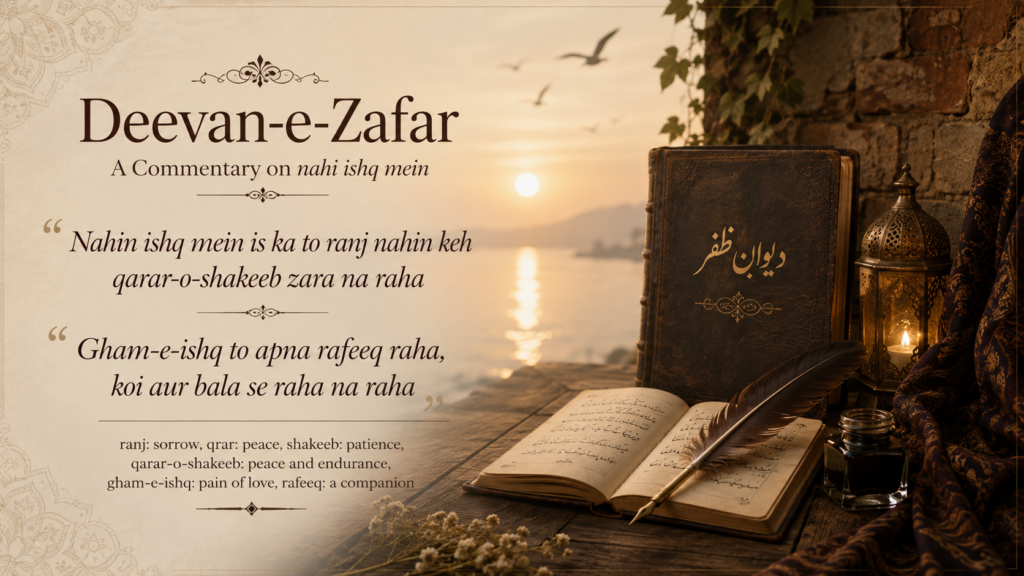
A Commentary on nahi ishq mein
Nahin ishq mein is ka to ranj nahin keh qarar-o-shakeeb zara na raha
Gham-e-ishq to apna rafeeq raha, koi aur bala se raha na raha
ranj: sorrow, qarar: peace, shakeeb: patience, qarar-o-shakeeb: peace and endurance, gham-e-ishq: pain of love, rafeeq: a companion
Commentary
When a person falls in love, nothing in the world matters to them. Their only destiny and desire remain the love of their beloved. In the first part of this ghazal, Zafar emphasizes that in falling for his beloved. In their love, he is not sad or in pain about the loss of his peace and patience. He is not at all worried about that, why? The answer to why comes in the next stanza where he says that it doesn’t matter if I had peace or endurance or anything. What matters most is that I was in love and I had pain in love. In this stanza, the poet is glamorizing in love. Because love requires us to give in everything that we have. Especially in the context of Muslim poetry and understanding of ghazal. So, in this process of giving in, nothing should remain of oneself. Which is very painful. So, the poet is glamorizing whatsoever I had the companionship of the pain of love.
Diya apni khudi ko jo hum ne utha, woh jo parda sa beech mein tha na raha
Raha parde mein ab na woh parda-nasheen, koi doosra us ke siwa na raha
Khudi: self-consiousess, parda-nasheen: observer of veil
Commentary
As I talked about losing one’s own self in love is the main aspect of love in Muslim poetry and understanding of love, in this stanza Zafar is talking about that same thing. He says that once I gave up my self-consciousness. Once I thought beyond my own self, the veil that existed between us didn’t remain. This stanza can also refer to the notion of eternal love (ishq-e-haqiqi). I believe it’s necessary to understand that there is a distinction between material love and eternal love (ishq-e-mijazi and ishq-e-haqiqi). In the ghazals and especially in Islam, there are two distinctions of love, one is for the world, and the other is for God. It is difficult in poetry to understand clearly if a verse is about God or a person, this ambiguity has helped many Sufis in making their message of oneness with God less evident.
I would like to go back to our initial discussion about this verse. So, whether eternal or material love, a person has to lose themselves to totally understand the other entity. Because when you have the distinction between me and them, you still have a distance and separation. In true love, there’s just one soul with two bodies. This is clearly illustrated in the second stanza when the poet says now in the veil the beloved doesn’t exist, not anyone else is there. Which in a metaphorical sense means that it’s just the lover that remains other than them; none remains.
Na thi haal ki jab hamein apne khabar, rahe dekhte auron ke aib-o-hunar
Pari apni buraiyon par jo nazar, to nigah mein koi bura na raha
Aib-o-hunar: vice and virtue
Commentary
There’s a famous saying of Hazrat Ali. Who is Hazrat Mohammed’s cousin and son-in-law, the fourth caliph and the first Imam of Shia Muslims. He said, the one who knows oneself, has known God. Through understanding our own desires and cravings, we can understand who we truly are. And that enlightenment will lead us to knowing God. In this verse, the author is referring to the human tendency to think of oneself as the perfect. In the first stanza, the poet says when he was not aware of who he was, he was looking at the vice and virtue of other people. Evaluating them, judging them. In the second stanza, he says, when I sat my eyes on my faults and vices, none remained faulty. The only person who was most at fault was just me.
Tere rukh ke khayal mein kaun se din, uthe mujh pe na fitna-e-roz-e-jaza
Teri zulf ke dhyan mein kaun si shab, mere sar pe jo barpa aza na raha
Rukh: face, Fitna: crime, fitna-e-roz-e-jaza: calamity of Day of judgement, dhyan:contemplation , aza: pain,
Commentary
In this verse the poet is beautifully expressing his love for his beloved in a painful manner. In the first stanza, he says whenever I think of your face, I go through the agony and pain which will happen on the day of judgement. He is referring to his state of heart in chaos and turmoil which will be there on the day of judgment. In the second verse, he adds by saying, the contemplation of your locks has never left me in peace on any evening. It has always left a throbbing pain. This verse is very simple yet very painful because of the choice of words and their relatability in real life situations. When stressed or stuck in a problem, the reaction of our heart is like this, I usually feel as if someone is squeezing my heart, it tightens and I could not breathe. That’s what’s the poet is referring to.