Abstract:
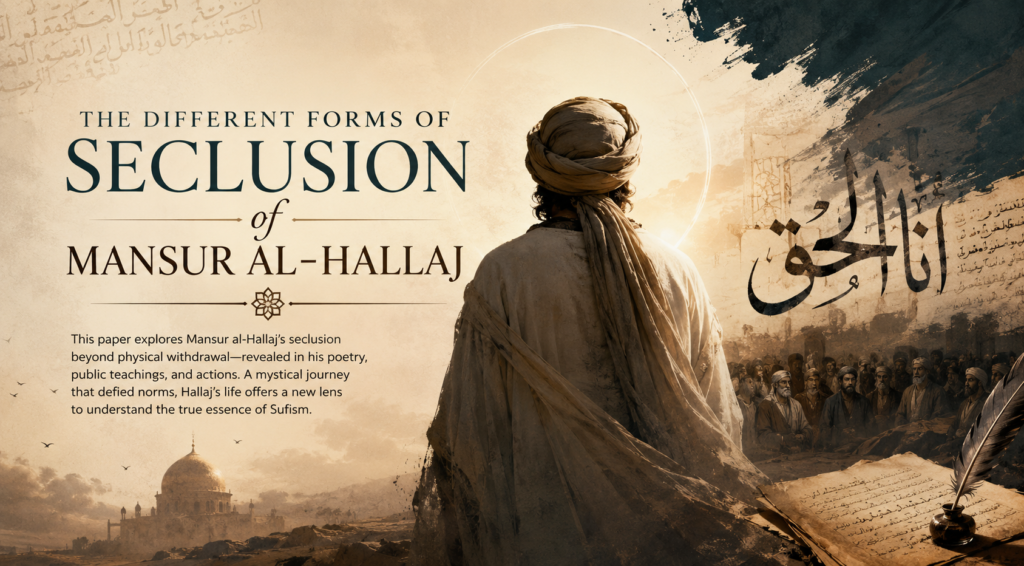
The concept of seclusion in Sufism is too often simplified to an ascetic’s withdrawal from the world, understood simply as a form of renunciation. In this research paper, I use the controversial figure of Mansur al-Hallaj, a Sufi mystic whose exclamations brought martyrdom to his fate, to challenge this view. I argue that Hallaj practiced a kind of seclusion, which was beyond the physical distancing of an individual. Hallaj’s seclusion was within his poetry, his public teachings, and his actions, evident that he is no friend of traditions nor bound to rules, he is man of his God. This paper is based on a detailed textual analysis of his poems, scholarly works on his life and teachings, and the anecdotes recorded by his disciples. My research aims to provide a new framework for understanding Sufism by analyzing Hallaj’s life on its own terms, moving beyond the politics of his death and the rigid structures of Sufism to explore the inner logic of his spiritual journey.
Introduction
“Finally, all were united in the view that he should be put to death because of his saying, ‘I am the Truth.”
“Say, Не is the Truth,” they cried out to him.
“Yes. Не is All,” he replied. “You say that Не is lost. On the contrary, it is Hosain that is lost. The Ocean does not vanish or grow less.”
“These words which Hallaj speaks have an esoteric meaning,” they told Jonaid.
“Let him be killed,” he answered. “This is not the time for esoteric meanings.” (Attar 360)
This excerpt is from a Sufi mystic, poet, and writer, Farid al-Din Attar’s book Tadhkirat ul Awliya (Memoirs of Saints). In which he has given concise biographies of Sufi saints. Contributing to making these figures immortal. One of the Sufi mystic’s that Attar talks about is Husayn ibn Mansur al-Hallaj. The above excerpt is related to Hallaj. It is representative of the fame Hallaj has gained in centuries after his death. His “blasphemous” exclamation, Ana’l Haq I am the Truth, that ended him in gallows and his distressing execution (Ernst 3), contrary to the view of his opponents made Hallaj alive centuries after his death.
Husayn ibn Mansur al-Hallaj was born in Fars in 858, a place where cotton carders(hallaj) like his father lived. He went to Basra with his sheikh and there became disciple of multiple Sufi figures among them was Jonaid, who later in Hallaj’s life “uttered his verdict” of death (Schimmel 66). Hallaj married another mystics daughter, and she became his only wife throughout his life. After Mansur’s martyrdom most of anecdotes and information came from his son Hamd. Hallaj’s father-in-law called Hallaj an “infidel” and a “sorcerer” (Schimmel 66). And after this he goes to Mecca and spends a year there when he returned his body was ready to be sacrificed and he was taken to the “slaughterhouse” (Attar 363).
He was a teacher of Sufism, on the day of his martyrdom hundreds of eyes cried and hundreds of others applauded. His death brought itself a question which would push researchers for decades to come to explore the mysteries of the world of Sufism where a Sufi is always dwindling between “faith and infidelity” (Ernst 56). Hallaj was so like his contemporaries in Sufism yet so prominent that he is one of the most celebrated Sufi mystics. With multiple translations of his work and ideas it has given more space to understand the mind of Hallaj in depth. Hallaj was born in a place which brought into life many well-known Sufis. The few famous names among them are Rabia Basri, Junayd al-Baghdadi, and Bayazid Bistami. Whether it was the influence of the land or the influence of his knowledge or his execution, there are people like Louis Massignon who have dedicated their lives to understanding Hallaj and his teachings (Schimmel 64).
What interested me about Hallaj was the fact that although there were other more prominent Sufi’s from Hallaj’s time. Yet his claim of “oneness with God” is something that was always apparent in scholarly debates that I was part of. So, after researching and analyzing multiple translations of his poems and biographies about him I came up with an answer. This answer is my understanding of why hallaj is such a great influence around the world form south Asia to Arabia (Schimmel article).
In this research paper I will try to understand seclusion in Hallaj’s life. I do not mean seclusion in this research as a detachment from people alone. This seclusion is in form of Hallaj’s poetry, teachings, and acts.
Sufism
“… In separation, separation left me / And I witnessed the Unknown” (Hallaj “You Went Away but Remained in Me”)
In our life there are moments when it feels like everything is slipping away from our hands, our plans, dreams and ambitions are slipping away and we are caged. But then we recover from these emotions and go on living our lives working hard to get on the trajectory that we initially made for our lives. It has always been like this. Birth, teenage, marriage, parenthood, old age and death. A planned script which subconsciously is embedded in every individual’s life, even if now people are free to choose what they want. The point of sharing this is for the sake of understanding Sufism. Sufism is a path which if someone trends, it starts off with the acceptance of tawhid and ends with oneness with god (Ernst 1). What happens in between is not planned nor decided by a Sufi. Some Sufis like Hallaj end up in river Tigris while others end their lives with processions (Attar 366). For a Sufi it is always him and God and other then that there is nothing. There is a total disconnection from the world in the form of ascetism that most of the Sufi’s exhibit. From “nudity” to “shaving all bodily hair”, “withdrawal from society” to “avoidance of gainful employment” (Karamustafa 10) Sufi’s break all the chains which bound them to any expression of ego. By doing these acts they believe they are winning to favor of God because to achieve God’s grace one has to destroy one’s ego (Karamustafa 11). Another most important aspect of Sufism is their batini (esoteric) explanations to religion in all instances. Sufis “avoid the shackles of literalism” in understanding Quran (Ernst 2). It is said in Sufism that there are two faces of religion, one is the exoteric and the other is esoteric. In exoteric form the words and sentences are read and understood as how they are. This is a traditionalist approach to understanding religion. Contrary to this, esoteric form of expression looks beyond the meaning of the sentence and tries to understand in as a connection to a bigger Reality. When the orthodox practitioners of Islam were stuck to the legal interpretations of Islam, the freedom of Sufism brought with itself the conflict of “human legalism” and Sufi interpretations (Ernst 3).
When traditions and exoteric practices made people parrots of religious teachings, and they started “blind acceptance” of what they hear from their ancestors, mysticism gave soul to the rules of Islam (Schimmel 68). Islamic mysticism is commonly known as Sufism. During his execution Hallaj gives a concise yet powerful defination of Sufism which reflects his state as a Sufi:
“Shebli came and stood facing him.
“Have we not forbidden thee all beings?” he cried. Then he asked, “What is Sufism, Hallaj?”
“The least part of it is this that you see,” Hallaj replied.
“What is the loftier part?” asked Shebli.
“That you cannot reach,” Hallaj answered” (Attar 364)
And right after this Hallaj was stoned. He is a Sufi who finds solace and peace in accepting death, for who has been “hacked off” his feet and yet he “smile[s]” (Attar 365). The history of Sufism gives us love stories, martyrdoms, and ecstasies. All which are separate in geographies but similar in essence. Each teaching, each narrative and poetry takes a reader to the world of ideas where forms are formless and souls are bodyless.
While studying works of various scholars on Sufism and trying to understand this esoteric tradition, I was fascinated by the constant reutterances of these words: “seclusion” (Karamustafa 46), “renunciation” (Karamustafa 44), and “separation” (Hallaj “You Went Away but Remained in Me”). These constant references made me realize that Sufis of the centuries highly value these concepts. My deeper research revealed that these terms weren’t only forms of expression but acts through which Sufi’s practiced their asceticism.
Like all Sufis Hallaj’s life is also influenced by seclusion. But when I explored hallaj I figured out the his life was not composed of seclusion in the sense that we commonly understand, which is that a person detaches themselves and meditate or pray or remain in solitude. This definition of ours is more of a physical detachment but in hallaj’ s case this detachment was more than a physical detachment. Massignon in his book talks about the difference between Hallaj and other mystics with this “freedom of behavior” was the “unusual number of people who turned to him as to a savior”, “calling him “the one who feeds”, “the one who can discern”, “the one who is enraptured in God”” (Abridged Edition133)
That’s why I categorize Hallaj seclusion into 4 prominent parts. Seclusion of poetry, seclusion of teachings, seclusion of acts, and seclusion from seclusion.
Seclusion in Poetry
Hallaj’s “rhymed prose and poetry” in different collections reveal his mystical states in the world (Massignon 278). His poetry is the evidence of his devotion to religion, God and society. His individuality is highly visible in all his poems. It is a primary source besides his lectures to know his ideas and thought process.
To further understand his poetry and how it is a form of seclusion I will use some of his poems. The first poem I chose, it reflects what he did in his whole life:
I witnessed my Maker with my heart’s eye.
I asked, ‘Who are You?’ He answered, ‘You!’
For You one cannot ask, Where?
Because where is Where for You?
You do not pass through the imagination
Or else we’ll know where You are.
You are He who is everywhere
Yet You are nowhere. Where are You?
In my annihilation is my annihilation’s annihilation
And You are found in my annihilation. (Hallaj “I Witnessed My Maker”)
In my study of Hallaj this is the poem which reflects his purpose of life. His journey starts from knowing God to travelling to various places, teaching people his teachings, realization of not finding Him and finally accepting annihilation as the gift of God (Massignon 6).
Like evident in Hallaj’s teachings (which will be discussed in later paragraphs) Hallaj’s poetry also reflects the annihilation of oneself for Oneness with God (Schimmel 70). The verse from one of his poems goes like, “stillness, then silence, then random speech / then knowledge, intoxication, annihilation” (Hallaj “Stillness”). In this simple verse we witness the theme of annihilation in Hallaj’s poetry. It feels as if he is sharing the process of annihilation which starts with stillness and ends in annihilation. And in between knowledge, intoxication, speech and silence is achieved. After studying many Sufis it’s not astonishing to hear about these stages of annihilation because this is the jest of Sufism for which the biggest example is Farid Uddin Attars Conference of the Birds which is a poem of journey of a flock of birds which are searching for their god this journey represents the stages in the life of a Sufi. This expression of annihilation is also evident in the Al Tawasin of Hallaj, which is his teachings from the times when he was in prison. In Al Tawasin he uses the example of moth and the flame which is again a recurring theme in Sufism in which the moth “castes” itself into the flame not for the light or heat but “never to return” to give information about “Reality” because it has reached perfection (Schimmel 70).
The second theme that I noticed while studying Hallaj’s poetry is the expression of Oneness, unity with god. Like in this verse from a poem, “I call You and You call me; / Did I say I am You / Or did You speak through me?” (Hallaj “I am at Your Service”). In this poem Hallaj’s “famous statement” Anna’l Haq (I am the Truth) becomes evident. There are other poems as well in which we see this poetical conformity of fana fi’llah (being one with God). It is evident in Sufi teachings that “…mystical experiences and thought cannot be rationalized and that it is dangerous to speak openly about the deepest mysteries of faith” (Schimmel 59). Its was for this reason a famous Sufi in the times of Hallaj, Junayd al-Baghdadi “rejected Hallaj” because he became a model of punishment for the open exclamations of the mysteries of love and unity which are prohibited (Schimmel 59).
This is a form of seclusion that can be seen in Hallaj’s poetry where he clearly declares his love and unity with the beloved. Like in the above poem where Hallaj is talking about a one-to-one conversation with god. But if we interpret calling as adhan which is Islamic call to prayer. Or a form of prayer in which the devote calls towards God for mercy and blessings. Hallaj is uttering his metaphors to say whether it’s I who is seeking help or giving devotion to God or it is god ho is devoted to me. The execution of Hallaj was not because of his one statement Anal Haq it was every act he did and every poem he said which became the building block for the gallows of his death. Massignon writes in his book that there is “no Arab mystic whose passionate language is both more ardent and purer than Hallaj’s”.
Seclusion of Teachings
Hamd, Hallaj’s son notes that when Hallaj returned from his third pilgrimage he was “changed” (Massignon, Abridged Edition 133). It was during this time that he built a house and started to preach a “doctrine” (Massignon 133 abridged). What he preached was against the orthodox views of Islam, so mystics and his former teachers disowned him from their circles. Yet there were people who accepted Masur as a miracle of God. But because of this division and constant debate the Sultan put him in prison (Massignon 133). If we take the jest of Hallaj’s teachings by the near end before his execution, he preached that true divine union is not emotional ecstasy or outward worship but annihilation of ego after which “the Creator ultimately joins his creature”. Like his teachings his ways of preaching were different. He left no stone unturned to seclude himself from the rest of the Sufi community. He preached while walking to “Attab Masjid to the Suq al-Qati’a and to his masjid”. Additionally, he preached in public in large crowds, when I read how he went into debate with people in the “markets” and gave preachings to moving crowds “preached”, it made me think of the way Socrates debated in public (Massignon 136).
The power of Hallaj can be understood by the influence he has on the people he preached. The reason of this comes from his life story in which he travelled to many lands as a wool carder “hallaj” and preached people towards god (Massignon 280). This is again one of the weapons people to accuse him of “blasphemy, while others considered him a secret Christian” to prove him as an outsider, a problem to the society (Schimmel 64).
Now I will use his Khutbahs (lectures) from the collection of Louis Massignon to analyze the seclusion of his teachings from rest of the Sufis.
I mentioned Farid Uddin Attar’s conference of birds before in which flock of birds travel through different places to eventually reach the “Simurgh” which is their God. These valleys through which these birds travel are a reference to the relation of “sheikh and pupil”. At the end of the journey, they see their reflection in the lake behind the veil where Simurgh was expected to be. The point of referring to Attar’s poem is to give the idea of the oneness in Sufism. Secondly in Hallaj’s lectures there is the expression in which Hallaj exclaims that God and he are one yet there is another veil using which God is hiding away. Here are some references to this kind of seclusion in his lectures in which he is opening the secrets and mysteries of Sufism which are not supposed oto be disclosed. Ibn Marduya said, “I saw Hallaj” in the masjid “… full of sorrow and crying out: “O people save me from God”” “… He has robbed me from myself, and He does not return me to myself!” (Massignon, Abridged Edition 142). In another narration we see the evident seclusion of his teachings when he talks about oneness but in the state of oneness God is still not there. As if he had come off, he ran instance and left. Just like the glance of the beloved with which the lover becomes addicted to their love. He says, “When God attaches Himself to a man, He kills in him all else but Himself!”, “… but what happens to me? I no longer feel the least breeze of His Presence, nor the least reach of his glance!”. Whether it be Attars Conference of Birds or Ibn al-Arabis stages of soul, after annihilation they do not express any lose in which God is lost. It’s oneness and eternal peace but for Hallaj there was more to it. Husayn ibn Hamdan in Louis Massignon’s Abridged Edition gives an account where Mansur says “… It is in the confession of the Cross that I will die; I no longer care to go to Mecca (Batha) nor Medina” (144). When Hamdan later asks about why he exclaimed such words, Mansur politely answers with, “that someone will kill this cursed one!”. For Mansur death was his only desire and he went to the extent of exclaiming things to die in the hands of someone who’s sentiments he may hurt.
While analyzing Mansur’s sayings which are narrated by his multiple disciples, another common theme that occurs in his lectures is pain and sorrow. Imagine a Sufi who has spent whole of his life praying for oneness with God and once he achieves it and exclaims it here, he is showing pain and sorrow. One narration says: One day he entered the mosque and gathered people to narrate a story and then said, “You must understand the God has made (the spilling of) my blood lawful for you, therefore kill me!”, a conversation goes on and it ends with Mansur saying: “… Kill me then, and you will be rewarded for it, and I will gain peace by it, for you will have fought for the faith and I, I will have died a martyr”(Massignon, Abridged Edition 146). While reading this piece and some other pieces in which Mansur is asking people to kill him I feel either he realizes the mistake he did by exclaiming oneness with God and revealing a secret which shouldn’t have been revealed, or he feels the body is a barrier now for reaching God and now this outer covering has to be shed (Schimmel 67). It feels as if Hallaj planned his martyrdom himself rather than the sultan announcing it. To prove my point, I will take the narration of Attar of Hallaj’s death, which astonishes me as a reader as to why a person would enjoy such a horrific death and a slightest emotion of fear does not appear:
“Then he rubbed his bloody, amputated hands over his face, so that both his arms and his face were stained with blood.
“Why did you do that?” they enquired.
“Much blood has gone out of me,” he replied. “I realize that my face will have grown pale. You suppose that my pallor is because I am afraid. I rubbed blood over my face so that I might appear rose-cheeked in your eyes. The cosmetic of heroes is their blood.”
“Even if you bloodied your face, why did you stain your arms?”
“I was making ablution.”
“What ablution?”
“When one prays two rak’as in love,” Hallaj replied, “the ablution is not perfect unless performed with blood.”” (365)
Seclusion in Action
Seclusion has been associated with Sufism since the beginning of time (Karamustafa 58). All Sufi’s from centuries practiced this as a form of asceticism and devotion to God (Karamustafa 61). This seclusion is a physical detachment in which a Sufi detaches himself in all forms to be visible as a mystic. Hallaj, he secluded himself from this idea of seclusion. Sufis detach themselves from the social orders and ways, but Hallaj amazes us by secluding himself from the normal notion of renunciation in the life of a Sufi and marries. He raises a son who becomes the most important source through which details about Hallaj’s life were found. That’s not only what he did, he also did networking with upper class people, now don’t get me wrong this was not for the sake of some gain but the idea is he didn’t keep himself detached from people. He made connections with Zoroastrians and Shiites as well (Massignon, Abridged Edition135). There are no exact references as to whether he continued working as a carder after returning to Baghdad, but he did live in the affinity of that area. His son also gives a detailed narration of his travels from India to Central Asia preaching (Massignon, Abridged Edition 6; Schimmel 67). It was after these travels that people started to accuse him of being a christen agent or someone who does sorcery (Massignon, Abridged Edition 7). The reason is these acts and then his teachings mentioned above raised a lot of concerns in people regarding him.
Conclusion
Hallaj’s life was not composed of seclusion in the sense we commonly understand. His detachment was more profound than physical. He secluded his poetry by revealing what others concealed. He secluded his teachings by preaching on an agonizing, public path to a union that was supposed to be a private, peaceful secret. And most profoundly, he secluded his very life from the model of the Sufi saint, choosing to live in the world, not apart from it. It feels as if Hallaj planned every step toward his own martyrdom, knowing that shedding the outer covering of his body was the only way to fully remove the final veil. His legacy is not just one of love, but of a deliberate and total isolation that made him a martyr, a mystic, and an immortal.
“Kill me, O my trusted friends
For in my death is my life.
To destroy all trace of my existence
Is the highest goal of my life” (Hallaj “Kill Me O, My Trusted Friends”).
Bibliographies:
- Arberry, A. J, translator. Muslim Saints and Mystics: Episodes from the Tadhkirat al Auliya’ (Memorial of the Saints) by Farid al-Din Attar. Omphaloskepsis, 2000.
- Ernst, Carl W. Words of Ecstasy in Sufism. State University of New York Press, 1985.
- Jamal, Mahmood, editor and translator. Islamic Mystical Poetry: Sufi Verse from the early Mystics to Rumi. Penguin Books, 2009.
- Hallaj, Mansur. “I Witnessed My Maker” Jamal.
- —. “You Went Away but Remained in Me” Jamal.
- —. “Stillness” Jamal.
- —. “Kill Me O, My Trusted Friends” Jamal.
- Karamustafa, Ahmet T. God’s Unruly Friends: Dervish Groups in the Islamic Later Middle Period, 1200–1550. University of California Press, 1994.
- Massignon, Louis. The Passion of al-Hallaj: Mystic and Martyr of Islam. Translated by Herbert Mason, Abridged Edition, Princeton University Press, 1982.
- Massignon, Louis. The Passion of al-Hallaj: Mystic and Martyr of Islam. Translated by Herbert Mason, vol. 3, Princeton University Press, 1982.
- Schimmel, Annemarie. Mystical Dimensions of Islam. The University of North Carolina Press, 1975.

Author Description:
Aiman Gohar – Student of Aga Khan University Faculty of Arts and Sciences.