
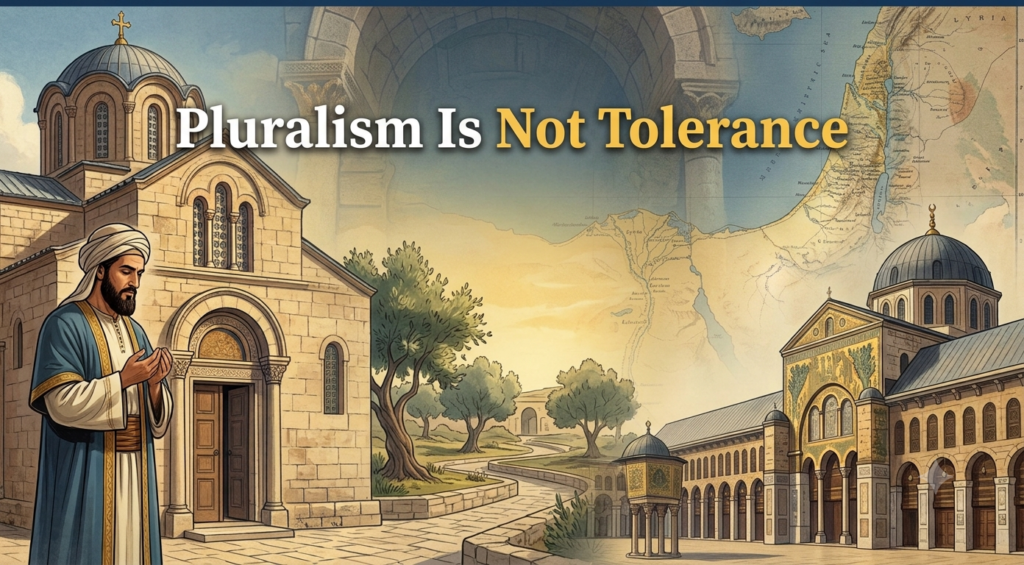
When Islam spread to Syria, Caliph Abu Bakr accompanied the early Muslim community into a land populated by large Christian communities. As prayer time drew near, the father of a famous church offered a portion of it for the Muslims to pray. Abu Bakr declined. He said, wherever I perform my prayers, my people will build a mosque there, if we pray inside the Church, building a mosque will destroy the antiquity of the Church. And so, he prayed beside that church. A mosque was later built. Which still stands today.
This is not simply a lesson in courtesy. It is a lesson in pluralism. Abu Bakr did not treat the Christian community as an obstacle to be tolerated. He treated their space with active respect and created something new alongside it. That is what pluralism looks like: two communities, side by side, each fully present, each fully themselves.
Now consider a different image. Two neighbors who live side by side. When they see each other, they nod and smile. There is no conflict, but there is utter ignorance in their interactions. Do you think this is pluralism? It is not. In any diverse society, people from varied cultures have the chance to produce something entirely new to the world, like different musical instruments working in harmony. But without that harmonious contribution, we cannot create music, only noise or silence. Pluralism is fundamentally distinct from mere tolerance. While tolerance is a passive act of enduring the other, pluralism requires active engagement, structural inclusion, and shared democratic participation.
Pluralism Demands Engagement, Not Just Coexistence
Diana Eck, one of the world’s leading scholars of religious diversity, identifies this clearly in her book A New Religious America (2001). Eck argues that the goal of pluralism is not simply tolerance of others, but an active attempt to arrive at understanding. You can tolerate a neighbor about whom you remain thoroughly ignorant. That stance, while preferable to conflict, is still far from genuine pluralism.
Pakistan offers a revealing example. Minorities are allowed to practice their faiths; churches, temples, and Gurdwaras exist across the country. But in 2018, when an Ahmadi financial advisor, Atif Mian, was forced to resign from the Economic Advisory Council to “maintain unity” (Al Jazeera, 2018), it became clear how shallow that tolerance really was. Secondly, the blasphemy law technically applies to everyone, but a mere rumor of blasphemy can send mob attacks rising like fire against minority communities and their places of worship (BBC, 2023). Their safety depends not on equal citizenship but on the mercy of a majority that can withdraw that mercy at any moment. Tolerance is not a guarantee. Pluralism means no group’s dignity is contingent on another’s goodwill.
Pluralism Requires Structural Equality; Tolerance Does Not
Consider the range of things we tolerate: a state can tolerate refugees, a person can tolerate a woman in the workplace, you can tolerate an unwanted guest. In each case, the one tolerating holds power. Tolerance is a gesture of those with the option to reject, choosing not to. Pluralism works differently. It means creating an environment where equal opportunities exist regardless of personal discomfort, where people can have a say without fear of judgment.
Robert Dahl makes this structural dimension explicit in On Democracy (1998). He argues that a genuinely pluralistic society requires a rich array of independent associations, and that no undemocratic arrangement should go unchallenged. J. Milton Yinger reinforces this in his essay “Pluralism, Religion, and Secularism” (1967), reminding us that a society can be descriptively diverse while its groups remain in deeply unequal positions. Diversity is not pluralism.
The class divide in Pakistan illustrates this starkly. Karachi holds both the wealthy elite and the working poor. The city is diverse, but the rich access the best private hospitals while the poor rely on government hospitals. A poor child cannot access quality education because of economic constraints. Both classes tolerate each other from an enormous distance, with no real relation between them. Tolerance allows you to say: I accept that you exist. Pluralism demands something harder: your voice matters as much as mine.
Tolerance Without Shared Space Produces Conflict, Not Peace
Yinger argues that pluralistic societies without shared secular participation, meaning shared civic spaces where different groups interact as equals, are generally unable to sustain even the basic mutual tolerance that diversity requires. Without those shared spaces, every community retreats into defending only its own corner, and the institutions that hold society together begin to collapse.
When wealthy and poor communities live in entirely separate physical worlds, with separate schools, hospitals, and social networks, they lose the ability to understand each other. The wealthy come to see the poor as a distant, abstract problem. The poor come to see the wealthy as an untouchable, indifferent elite. That mutual ignorance eventually produces social rupture: protests, crime, political polarization, and instability. Not because people stopped tolerating each other, but because tolerance was never enough. Genuine pluralism would require integrated public schools, shared parks, and shared civic institutions. Not coexistence behind walls.
Rebuttal
Someone might reasonably argue that tolerance is a necessary first step, and that forcing engagement before people are even tolerant of each other could make things worse. This is a fair point. Yinger himself acknowledges that tolerance creates the conditions in which mutual respect becomes possible. The argument here is not that we should discard tolerance. The argument is that we should refuse to be satisfied by it. When we mistake the starting line for the finish line, we stop moving. As Eck reminds us, you can tolerate a neighbor about whom you remain thoroughly ignorant. That is not pluralism. That is social stagnation dressed up as progress.
Conclusion
We began with Abu Bakr beside the church in Syria, and with two neighbors who nod at each other and know nothing about each other’s lives. The distance between those two images is the distance between pluralism and tolerance. Pluralism is not tolerance. Tolerance is passive and asks nothing of us. Pluralism is active and asks us to engage across differences, to build structures where every group has equal voice, and to create shared spaces where communities are genuinely building something together. The world does not need more societies that merely tolerate each other. It needs more societies that are genuinely, actively, and structurally pluralistic. And the first step toward that is understanding the difference.
Bibliography
Al Jazeera. (2018, September 7). Bowing to far-right pressure, Pakistan removes Ahmadi adviser. https://www.aljazeera.com/news/2018/9/7/bowing-to-far-right-pressure-pakistan-removes-ahmadi-adviser
BBC News. (2023). Pakistan: Attacks on minorities and their places of worship. https://www.bbc.com/news/world-asia-66525150
Dahl, R. A. (1998). On democracy (pp. 116–118). Yale University Press.
Eck, D. (2001). A new religious America. HarperSanFrancisco. [As cited in Hussain, A. (2009). Islam in the plural. In A. B. Sajoo (Ed.), A companion to the Muslim world (pp. 87–108). I.B. Tauris.]
Yinger, J. M. (1967). Pluralism, religion, and secularism. Journal for the Scientific Study of Religion, 6(1), 17–28.