
Will AI Take Your Job?
Artificial intelligence (AI) is transforming people’s work patterns, businesses’ operations and organisational decision-making. It is impacting almost all industries, from customer service to coding assistance.
As 2030 draws near, many fear that AI will take over human efforts and lead to mass unemployment. However, while AI will undoubtedly automate some jobs and tasks, it is unlikely to eliminate human employment altogether. The outcome will depend on how individuals, businesses and governments adapt.
Which Jobs Will AI Automate First?
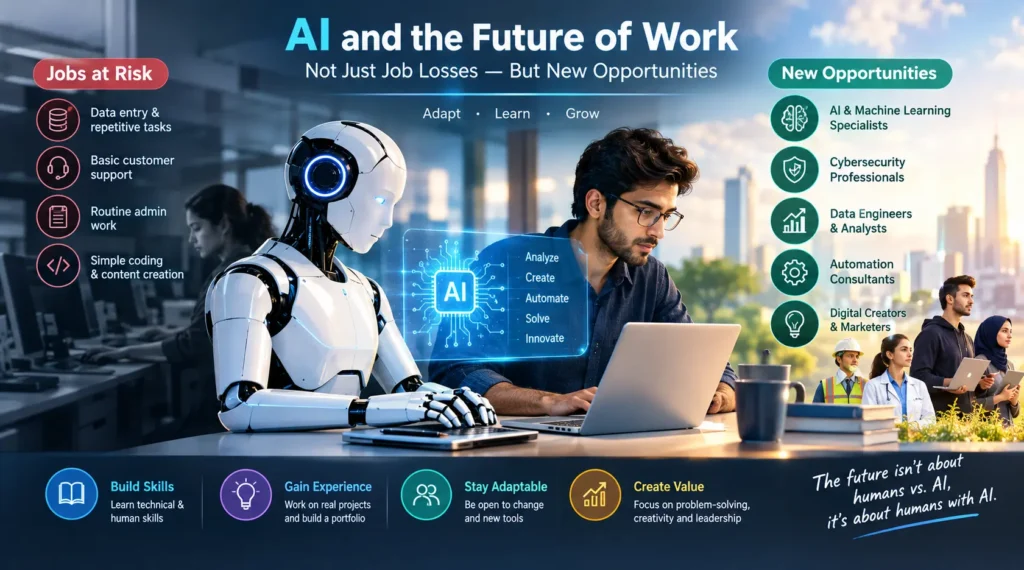
Jobs that involve routine and repetitive tasks are the most at risk. Many organisations are already using AI-powered tools for data entry, basic document preparation, Appointment scheduling and simple customer inquiries. Chatbots can answer frequently asked questions, and AI software can process vast amounts of information in seconds.
As these tools become more affordable and powerful, some businesses will need fewer people for such tasks, which can reduce costs and improve productivity, but it can also create significant challenges for people whose jobs are primarily routine-based. The scale of job losses will depend on the organisation, the industry and the country.
How Is AI Changing Software Development?
AI coding assistants can write code, explain errors and suggest improvements, helping developers complete projects more quickly. This will change the nature of the work required of developers, but it is unlikely that they will be entirely replaced by AI.
Developers will need skills in system architecture and design, cybersecurity and databases, software quality and testing, and understanding business requirements. They will also need to review code produced by AI, which can contain errors, security vulnerabilities or inefficient solutions. Developers who combine fundamental knowledge of software development with AI-assisted tools will be more productive and able to solve more complex technical challenges than those who rely solely on code generated by AI.
How Is AI Changing Data Analytics?
Data analysts have traditionally used Excel, SQL, Python and Power BI to clean data, perform calculations and create visualizations. AI can generate formulas, write queries, prepare reports and suggest charts.
However, data analysis is not just about producing a chart. An AI tool might indicate that sales have decreased, but a skilled analyst will need to identify why this is the case: pricing issues, competition, customer behaviour or something else. The analyst will need to assess the quality of the underlying data, investigate any apparent anomalies and provide an explanation of what drives the results in business terms.
The analysts who will thrive are those who combine technical skills with critical thinking, communication and business acumen.
How Is AI Changing Digital Marketing and Creative Work?
Businesses can use AI to create captions, ad copy, product descriptions, images and campaign ideas, saving time and effort. However, successful marketing requires an understanding of customers, brand-building, target audiences and measurement of results.
AI-generated content can be generic or even misleading; human creativity and strategic thinking are still needed to resonate with customers. Designers, writers and marketers who can harness the power of AI while avoiding its pitfalls will have an advantage.
What New Jobs Will AI Create?
AI adoption will create new jobs in AI engineering, machine learning, data engineering, cyber security and automation consultancy. Businesses will need to hire people who can integrate AI into their systems, protect sensitive information, evaluate AI models and ensure that they are used responsibly. Some of the jobs that AI will create we cannot yet imagine.
The World Economic Forum’s Future of Jobs Report 2025 predicts that broader labour-market changes will create about 170 million jobs and destroy 92 million jobs by 2030, a net gain of 78 million. These figures should be seen as employer expectations about many economic and technological forces, rather than a guarantee that AI alone will produce this net gain, but they demonstrate that technological change eliminates some roles while creating others.
What Does This Mean for Pakistan and Other Developing Countries?
The effects of AI on jobs will not be evenly distributed. People with limited access to education, digital resources and training may struggle to adapt. Young graduates may find it challenging to get started if employers automate the entry-level tasks that once provided experience. In Pakistan, roles in basic data processing, administration and online services may become more competitive.
However, Pakistan has significant opportunities in software exports, freelancing, e-commerce, digital entrepreneurship and technology services.
To benefit from these opportunities, students and professionals should develop practical skills, strengthen their English and communication, create portfolios and learn to use AI tools responsibly.
What Skills Will Matter Most by 2030?
Continuous learning will be essential. People will need to update their skills constantly or risk falling behind. Educational institutions and employers should encourage digital skills, analytical thinking and communication, and teach the principles of AI. Individuals should focus on understanding their chosen field, rather than memorising procedures that software can automate.
For example:
Aspiring data analysts: learn Excel, SQL, Power BI and Python, along with statistics and business decision-making.
Software developers: learn programming fundamentals, databases, application security and system design, and use AI as an assistant.
Practical experience, such as internships and projects, can demonstrate these skills to employers.
What Should Governments and Businesses Do?
Managing this transition will be challenging for governments and businesses. Companies should re-skill their employees when their roles change, rather than simply laying them off. Governments can make technical education and digital infrastructure more accessible and provide career guidance and job-transition support, while ensuring that people are not exploited unfairly during the transition.
Businesses also must address privacy, cyber security, bias, accountability and the accuracy of AI decisions. A responsible approach will allow them to reap the benefits of innovation without ignoring the social and economic costs.
You can also explore latest articles in Saju Content
Conclusion
AI will undoubtedly transform employment by 2030, automating some jobs and tasks, reshaping professional roles and eliminating some jobs, while creating opportunities in new industries and helping people work more efficiently. The critical challenge will be ensuring that people have the knowledge and resources to adapt.
Workers who continue to learn, think critically, understand their industries and use AI to their advantage will have an enormous opportunity. Rather than fear AI or expect it to be a panacea, it should be seen as a powerful tool that requires human judgment and responsibility. Ultimately, the impact of AI on work will depend not only on what the technology can do but also on how society chooses to use it.
References
World Economic Forum, Future of Jobs Report 2025: https://www.weforum.org/publications/the-future-of-jobs-report-2025/