
Introduction
Islam in literal meaning is submission. In the religion of Islam, the submission is towards God. Your wealth, health, and dignity, you devote to God. What is noteworthy is that this submission is not unequal to women or men; it is equally obligated in both sexes. However, we see a contrasting idea of submission for men and women in Islam. Men need to submit to one God, but women need to submit to two gods: the first being the Ultimate Truth and the second being the men of the family, be it their fathers, brothers, husbands, or even sons.
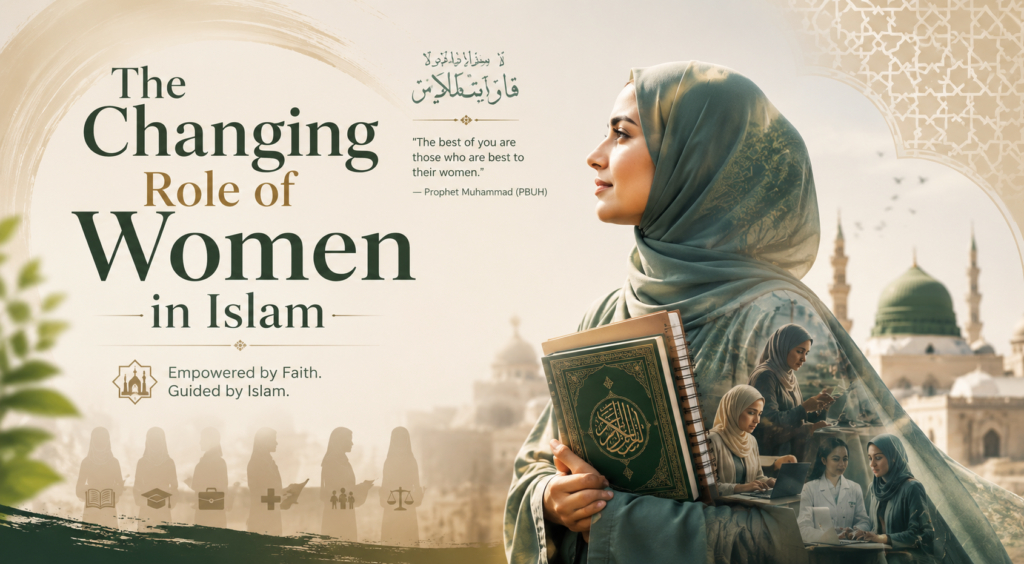
To understand this distorted image of the role of women in Islam, this essay will analyze three eras of Islam. When we raise the question of the role of women in Islam, we should not look at contemporary explanations alone, because it will give us one side of the picture. For the other half we need to look at the times of the Prophet, when he made rules and people followed them. There was no division of authority, no Karbala, no wars among Muslims. This period will show us the role of women in the Islam which the Prophet brought, and then we can move to the contemporary times and see how that role has been understood and reshaped. The role of women in Islam changed significantly over time, shaped first by the Prophet’s reforms, then altered by the political and religious struggles that followed his death, and continuously reinterpreted in contemporary discourse.
Although Arab was a matrilineal society, it was still very patriarchal. We see examples in the Quran which talk about how the birth of female offspring was seen as a taunt. Moreover, there were some societies where female infants were buried alive (Quran 16:58-61). Women were seen as property of men, and only the elite could take part in social life. In the Arab world women had no right to own property; Khadija and some women are exceptions. Khadijah not only owned property but traded as well. Khadija was the first to accept Islam. When the Prophet was distressed by the first incidents of the revelation, she comforted him by saying he was the chosen one.
In such a place, when Mohammed brought his reforms which gave women a higher role in society, many could not accept them. In A Companion to the Muslim World, this is interestingly explained on the basis of polygamy and divorce. Even during the Prophet’s time there were many people who thought the reforms he was bringing in favor of women were taking away the agency of men in society. Some people left Islam for these reasons as well (Al-Hibri 134). These early tensions between the Prophet’s egalitarian vision and the resistance of his society set the stage for everything that followed.
Role of Women in the Time of the Prophet
Islam is a religion of justice. By justice I do not mean something abstract and outside of the context of Islam. Hazrat Ali, the fourth caliph and the first imam of Shia Islam, defined justice as putting one thing in its right place, to where it belongs (Kazemi). This is not as simple as it seems because there is no way to decide the right place of anything in the world; it is far too complex. But if we take this definition, through his reforms the Prophet made attempts to put things in their right place, be it the oppressed slaves, war prisoners, or the segregated women in Arab society.
Islam separated itself from Christianity clearly in its verses, regardless of being an Abrahamic religion. One of the distinctions that the Quran made was in verses (4:1; 6:98; 7:189), which emphasize that men and women were created from a single soul. It says that both Adam and Eve were tempted by the devil, which led to their fall from the heavens. The Quran does not blame Eve for the first sin, nor does it say women were made from the ribcage of men. The Quran gives justice to both sexes starting from the creation of the world, putting them at the same hierarchical starting point and defining women as completely independent spiritual beings (Al-Hibri 139).
The Quran itself states the rights of Muslim men and women over their earnings (4:32), which means women have the independence to earn just as men do. The Prophet had “benefited from the wealth” of Khadijah for a long time (Aslan 36), and he made reforms to give equal opportunities to women. He introduced inheritance laws as well as the right of a woman to divorce her husband. These reforms were not taken positively. If this was not enough, the Prophet also limited the number of marriages a man could have. Although there is a verse which talks about marrying up to four wives, in the later part of the same sura it is said that it is impossible to do justice to all four, so marrying just one is enough.
Many novices in the world of feminism see western feminism as the epitome of women’s rights, but when examined critically we notice extreme politicism in it. Women advocate for the women of Afghanistan not being able to get an education and donate money, trying to show the world they are helping, but why are they silent when their own countrymen are raping women in warzones at this very moment? Things are not as simple as they seem. In her essay, Azizah Yahia Al-Hibri says that the women she spoke to did not have any issues with the veil. They were fine with it; it was not a big deal. But they were more interested in having the family law and laws of inheritance, which were established by the Prophet, properly implemented (Al-Hibri 134).
Role of Women After the Prophet
The death of the Prophet opened a crisis of authority that would reshape Islam for centuries. The Quran is a book of metaphors; it is written inside it that no one can understand it other than those “perfect in Knowledge,” rasikhun-fil-ilm. In the times of the Prophet, when people had issues understanding a verse, they would reach out to him and he would explain the ayah. The same went for any social issue; people would go to the Prophet and he would give a possible solution within the boundaries of the ethics of Islam. But after his death this authority was contested. The role of caliphs was more political than spiritual. Additionally, the hadith were compiled after nearly 100 years of the Prophet’s death, which makes their “authenticity impossible” (Aslan 42). In later centuries, when someone had the power and authority to influence society and wanted to justify a position on any topic, for example the role of women, they would simply refer to a hadith:
“which he had heard from someone, who had heard it from someone else, who had heard it from someone else, who had heard it from a Companion, who had heard it from the Prophet” (Aslan 42).
After the Prophet the biggest question was who would lead the Muslim Ummah. Because in some traditions the Prophet did not appoint any successor, two criteria were selected using Hadith, Quran, and Sunnah to determine who should be caliph. These were later also used by Ayatollah Khomeini in his revolution in Iran to legitimize his power: “to assure social justice by choosing a chief of state who will be inspired by sharia for heading the people and administering them” (Mernissi 32). The four caliphs were legitimized with this criterion. When, during the time of Hazrat Ali, Ayesha waged war against him and the Muslim Ummah went into a fitna, a civil war, it became necessary to compile hadith to understand what the Prophet’s guidance was on such matters.
Fatima Mernissi, in her book The Veil and the Male Elite: A Feminist Interpretation of Women’s Rights in Islam, accounts two hadith transmitters who made striking comments about the role of women after the death of the Prophet. The first one was Abu Bakra (not to be confused with Abu Bakr the Caliph), and the second one was Abu Hurayra.
Abu Bakra is reported to have said that he heard the Prophet say: “Those who entrust their affairs to a woman would never know prosperity” (Bukhari 226). If we look into the life of Abu Bakra, we see that he came from a slave background. The Prophet freed some slaves after capturing a city, and Abu Bakra became a well-known and wealthy person with considerable influence, an example of Islam as a religion that gave equal opportunity to everyone. He shared this hadith after the fitna, the civil war between Ali and Ayesha, in which Ayesha lost. Before the war, both Ayesha and Ali sent proposals for support to their governors and officials. Among those who stayed neutral was Abu Bakra, who declined to support Ayesha. Then, after Ayesha lost the war, he suddenly remembered the Prophet’s hadith claiming the above words. Now only God knows the truth, but a critical analysis of Abu Bakra’s life reveals that he was not a reliable source for such a claim. He had been flogged for a false accusation of zina. He always remembered hadith when a situation required a hadith’s approval to benefit him, as happened again when he suddenly recalled that the Prophet had said Hazrat Hussain is a mediator. His words are not accepted by all scholars, but neither are they universally denied. People like him became the stepping stones for the oppressed position of women in Islam.
Another example is Abu Hurayra, who reported: “The Prophet said that the dog, the ass and woman interrupt prayer if they pass in front of the believer, interposing themselves between him and the qibla” (Bukhari 99). The name given at birth, in Yemen, to Abu Hurayra was Abd-al-Shams, meaning Servant of the Sun. The Prophet changed it to Abd-al-Allah, Servant of God, when he converted to Islam. So why do we call him Abu Hurayra? This name means Father of the Little Female Cat, a nickname given by the Prophet because he used to carry a cat with him everywhere. Interestingly, Abu Hurayra disliked the femininity in that name, since it referred to a female cat and not a male cat. He even claimed the Prophet had actually said Abu Hirr, meaning father of a male cat. This reveals a personal discomfort with the feminine. He made many other claims about women and their duties, many of which Ayesha confronted and corrected when she heard them. In answer to this particular hadith, Ayesha is reported to have said: “I slept and the Prophet prayed in times I would be between him and qibla” (Bukhari 199).
Role of Muslim Women in Modernity
The contemporary debate on women in Islam cannot be separated from the question of whose interpretation holds power. Imagine a woman who is beaten every day by her husband in front of her children. She is told by religious authority that she cannot leave him. She tolerates it for decades, and when she finally decides to run away, the police find her and return her to her husband regardless of what he has done. This is a fictional situation, but the reality in Egypt would not have been very different a few years ago. Al-Hibri brings an important point here: when the customs of a tradition are mixed with Islam, it creates laws which are not in the Quran but in the tradition (Al-Hibri 147). Unfortunately, these laws are followed by people because of their lack of religious knowledge. Although much has changed now, the agency of women is still at stake in such contexts.
The contemporary debate on women in Islam cannot be separated from the question of whose interpretation holds power. Imagine a woman who is beaten every day by her husband in front of her children. She is told by religious authority that she cannot leave him. She tolerates it for decades, and when she finally decides to run away, the police find her and return her to her husband regardless of what he has done. This is a fictional situation, but the reality in Egypt would not have been very different a few years ago. Al-Hibri brings an important point here: when the customs of a tradition are mixed with Islam, it creates laws which are not in the Quran but in the tradition (Al-Hibri 147). Unfortunately, these laws are followed by people because of their lack of religious knowledge. Although much has changed now, the agency of women is still at stake in such contexts.
The larger question remains: what does Islam mean for women in modern times? There are thousands of interpretations of Quranic verses and hundreds of scholarly reforms in books, but when it comes to Muslim women today, the conversation is often framed through a western lens that has its own agenda. As Lila Abu-Lughod argues in her essay, western concern for Muslim women has historically been used as a tool of power, noting that the condemnation of practices such as “sati (the practice of widows immolating themselves on their husbands’ funeral pyres), child marriage, and other practices was used to justify rule” (Abu-Lughod 784). Western ideals and feminism have often served not Muslim women, but the colonial projects of those who ruled over them.
Conclusion
Islam sets women in a prestigious position from its very start. The Quran never distinguished between men and women, whether in religious circumstances or in social life. Women are allowed to earn, to hold property, to inherit, and to have choice over their own lives. Unfortunately, patriarchal interpretations accumulated over centuries and political manipulations of hadith created an illusion that Islam makes women inferior. There is a need to revisit what has been written by male jurists and scholars of Islam who, consciously or unconsciously, brought their own biases about gender roles into their teachings. The scholars referenced throughout this essay are among those working on this cause. The purpose of this essay has been to trace that long arc, from the Prophet’s egalitarian reforms, through the politically motivated distortions that followed his death, to the ongoing contemporary struggle to reclaim what Islam actually says about the role of women.